Picture this. The builder's van says Established 1985. You look the company up on Companies House, the way our vetting guide suggests, and the register says the company was formed in 2021. You read it twice. Thirty-six years of history, and the official record shows five? Both can be true, and usually both are. A tradesperson can spend decades as a sole trader, working under their own name, before an accountant suggests forming a limited company. The day that company joins the register has almost nothing to do with the day they first picked up a trowel. So before you treat a recent registration date as a warning, it is worth knowing what the register actually looks like for the trades. We ran the numbers on the companies behind the businesses we list, and the picture is younger than almost anyone expects.
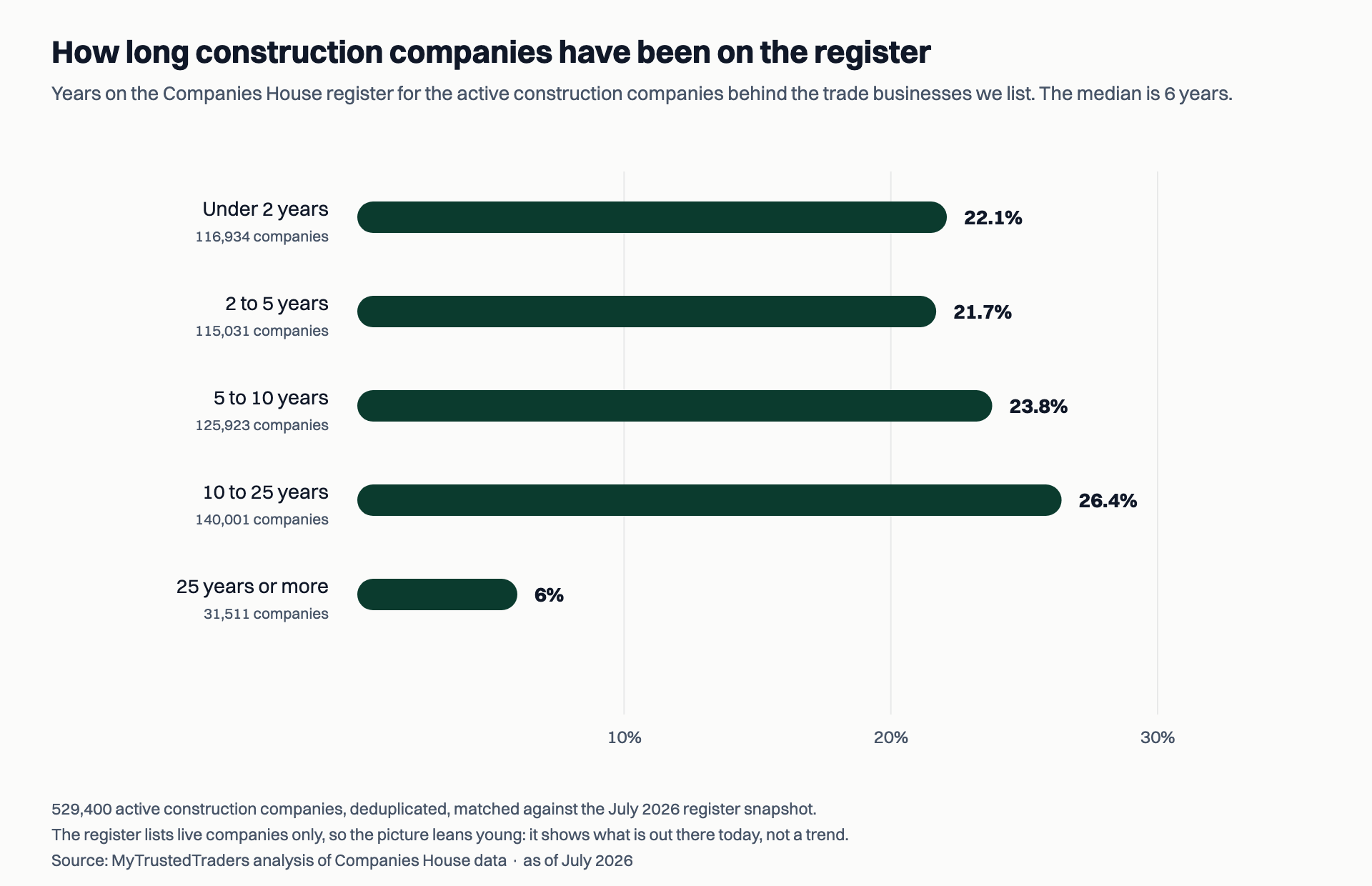
Is a young company a red flag? Not by itself. Across the roughly 530,000 registered companies behind the construction-trade businesses we list, the median company has just six years on the register, and about a third have ten or more. A recent registration date often means a business changed shape, not that it appeared from nowhere.
What the register actually shows
The chart above covers the 529,400 active construction companies behind the trade businesses we list, matched against the July 2026 Companies House register and counted once each, however many listings they stand behind. More than one in five joined the register within the last two years. Roughly two in five joined within the last five, and about two thirds within the last ten. If you have been treating ten years of company history as the baseline for trustworthiness, the register disagrees: only about a third of these companies clear that bar.
Every trade has its own clock
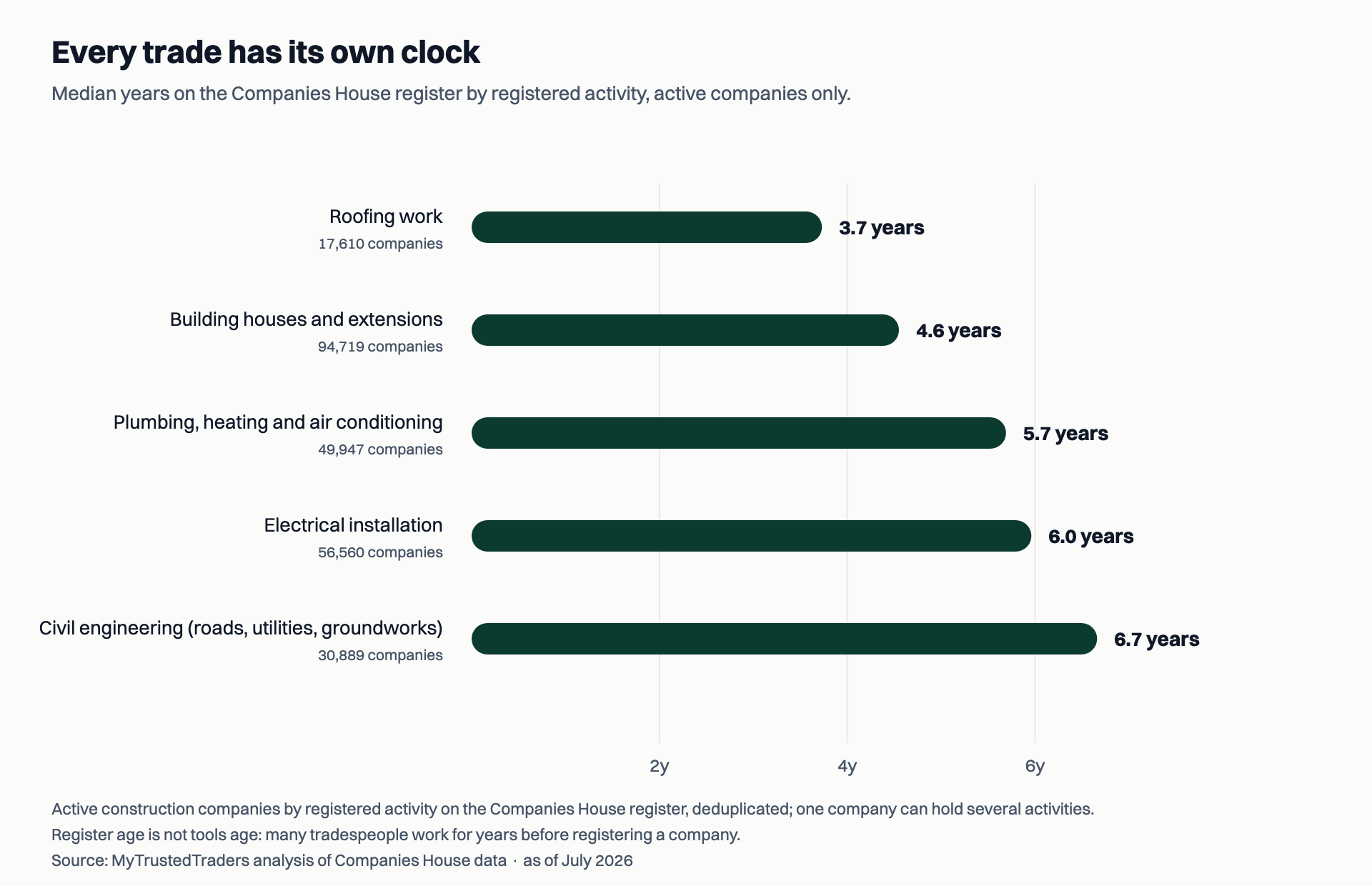
Age reads differently depending on what the company does. The median roofing company on our books has 3.7 years on the register. The median civil engineering company has 6.7. Companies registered for building houses and extensions sit at 4.6 years, plumbing and heating at 5.7, electrical installation at 6.0. None of this says anything about quality. It tells you how each field is structured: trades where one person and a van can do excellent work tend to produce younger companies, because people work for themselves first and register a company when the paperwork starts to demand it. A three-year-old roofing company is not an outlier; for its field, it is the norm. Calibrate against the right clock before you read anything into a date.
Why young doesn't mean new
The register records when a company was formed, not when a person started working. And companies get formed for reasons that have everything to do with paperwork and nothing to do with experience. A sole trader crosses the VAT threshold and their accountant suggests incorporating. A contractor needs a limited company to get onto a site or through a big firm's payment system. Two partners split and each registers their own company. An insurer or a main contractor asks for it. In every one of those stories, the person holding the tools is exactly as experienced the day after the company forms as the day before. Among the companies we looked at whose registered activity is building houses and extensions, just over half joined the register within the last five years, across 94,719 companies. That is not a wave of beginners. It is what a trade full of experienced people formalising looks like.
You can even see the paperwork rhythm in the dates. March, just before the tax year ends in early April, accounts for 11.2% of these companies' incorporations, while December, when nobody wants to think about forms, accounts for 6.1%. The gap moves around from year to year, so we would not lean on it too hard, but the shape fits: companies are formed to an accounting calendar, not to the moment someone becomes good at their job.
What age really changes: how much history you can check
Here is the reading of company age we think actually helps: it is an evidence signal, not a quality signal. An older company has left a longer paper trail. Years of filed accounts you can skim for free, a longer run of dated reviews, more finished jobs you can ask about. A younger company has left a shorter one, so the checking weight shifts from the company to the person. Credentials that attach to the person still count in full, whatever the company's age: a Gas Safe registration, an electrician's scheme membership, a track record under a previous trading name. References still count, and so do photos of finished work. And the people behind any company are public. Every company's filing history and its directors, including what else those directors run or ran, is free to read on Companies House. A young company run by someone with a long, visible history is a very different thing from a young company with no history anywhere. The date alone cannot tell you which one you have. The rest of the record can.
When a young company follows an old one
Sometimes the story behind a young company is that an older one closed. That sentence sounds sinister and usually isn't. Companies close because their owners retire, restructure, simplify their tax affairs, or take a break, and honest businesses do sometimes fail. Government guidance from the Insolvency Service is clear that starting a new company after a previous one became insolvent is, in most circumstances, entirely lawful. Some homeowners have learned the word phoenixing for the bad version of this pattern, and the bad version does exist. But you cannot identify it from one closed company, and you should not try to. What you can do is read the public record. A director's page on Companies House lists their other appointments, past and present, for free. One previous company that closed tells you almost nothing. A different picture, several recently dissolved companies in the same trade, paired with reviews on more than one site from customers describing unfinished work or lost deposits, is worth taking seriously. The signal is the repeated pattern across public sources, never the single closure.
The long game
The other end of the range deserves a mention, because it is quietly remarkable. Among the active construction companies we looked at, around 31,500, about 6%, have been on the register for 25 years or more. 815 were registered before 1950, and 179 have passed their century. Longevity like that is real evidence: decades of filed accounts, survived recessions, generations of customers. The oldest of them joined the register in 1856, before the telephone existed. If you are choosing between two otherwise similar quotes and one company has that kind of history, it is fair to let it count. Just remember which direction the logic runs: a long history is a genuine positive, but a short one is not a negative. It is simply less paper to read, and the person behind it may have been working for decades.
How to weigh it when you're choosing
- Look the company up. The incorporation date, filing history and directors are free on Companies House, and our guide to checking a builder's company before you pay walks through the whole ten-minute check.
- Then read the age against the right clock. The median here is six years on the register, and a young company in a young field like roofing is normal. Let the date tell you how much history there is to check, not whether to walk away.
- If the company is young, check the person. Personal credentials, reviews under previous trading names, references and finished work carry the weight the filing history cannot yet carry.
- Whatever the age, keep the money protections: staged payments, protected deposits, and a credit card for at least part of qualifying bills.
Questions homeowners ask
My builder's company is only 18 months old. Is that a red flag?
Not by itself. More than one in five of the active construction companies behind the businesses we list joined the register within the last two years, and the median across all of them is just six years on the register. A young company often means a business changed shape. Perhaps a sole trader incorporated, partners split, or a contract came along that required a limited company. Put your checking weight on the person instead: credentials, references, reviews under any previous trading name, and photos of finished work.
The van says established 1985 but Companies House says 2021. Are they lying?
Usually not. The register records when the limited company was formed, not when the person started trading. Decades of self-employed work never show on Companies House, so a business genuinely established in 1985 can sit behind a company registered in 2021. If you want comfort, ask what the business did before incorporating. A straightforward answer is common, and it is worth more than the date.
My tradesperson is a sole trader with no Companies House record at all. Is that bad?
No. Sole traders do not appear on the company register, and a large share of good tradespeople work that way their whole careers. Absence from the register is normal, never a warning sign. It just means your checks run through other doors: personal credentials, reviews, references and insurance rather than filed accounts.
Their previous company was dissolved. Should I walk away?
Not on that fact alone. Companies close for ordinary reasons: retirement, restructuring, or an honest failure, and government guidance is clear that starting again after an insolvency is usually lawful. The picture that deserves caution is different: several recently dissolved companies in the same trade, paired with reviews on more than one site describing unfinished work or lost deposits. Check the director's history free on Companies House, and whatever you decide, keep staged payments and deposit protection in place.


Comments